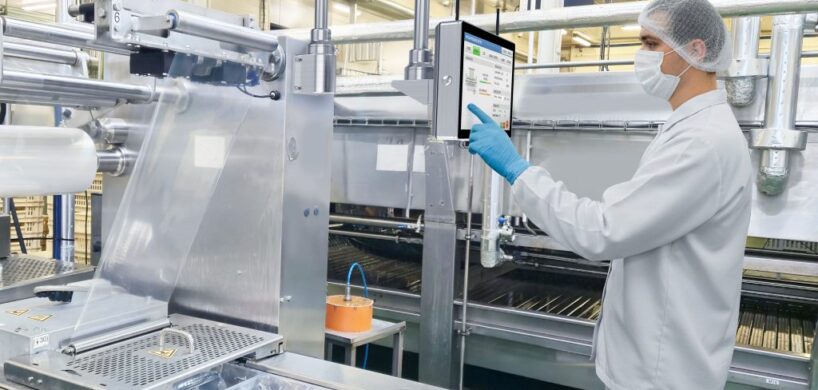

At food processing facilities, critical computing platforms play a key role in controlling and monitoring production. This equipment can come in many forms, including thin clients, panel PCs, remote touch displays, and fixed and mobile operator workstations.
Because these devices are typically installed near processing areas and exposed to frequent washdowns, they must be constructed from stainless steel with sealed, durable housings that support washdown sanitation and prevent contamination.
However, durability alone no longer meets the needs of these production environments. Conventional workstation configurations continue to depend on permanent wiring and complex installation requirements. When layouts change or equipment is moved, cables must be rerouted, limiting flexibility on the plant floor.
To overcome these constraints, engineers are adopting centralized session management platforms that separate computing from the workstation itself. In food processing, many now rely on ThinManager® from Rockwell Automation to manage this architecture.

Centralized Control
ThinManager allows facilities to consolidate computing power in one secure location while streaming operator interfaces to lightweight, remote terminals called thin clients.
Rather than running Windows and industrial applications locally, each terminal connects to the ThinManager server, which dictates exactly what appears on its screen, who can access it, and how it behaves. The result is a simplified, secure, and easily managed environment.
For many manufacturers, this centralized model has made ThinManager-Ready thin clients a standard requirement for new installations.
As the name implies, “ThinManager-Ready” means the hardware has been built and certified to integrate directly into the ThinManager ecosystem without additional setup or configuration. From the moment the device powers on, the thin client identifies itself to the server, downloads its configuration, and connects to the assigned operator session.
That readiness eliminates the need for manual setup or software installation, reduces downtime, and ensures full compliance with Rockwell’s industrial security framework. These are key priorities for plants where reliability and uptime are non-negotiable.
But even with this streamlined architecture, thin clients have relied on one critical tether: the Ethernet cable. Each terminal needed a physical network connection to contact the ThinManager server, a limitation that becomes costly and cumbersome in clean or controlled environments.

Wireless Flexibility
In food processing, hard-wired Ethernet connections add complexity while limiting mobility. Each cable must be sealed, inspected, and revalidated, making even small layout changes time-consuming and costly.
This is where Wi-Fi Boot shows its true advantage. By allowing thin clients to connect to ThinManager entirely over wireless, the technology eliminates the need for physical network cabling. When powered on, the terminal’s wireless module connects securely to the facility’s Wi-Fi network before any operating system loads. Then, it locates the ThinManager server, downloads its operating image, and begins displaying the assigned control interface within seconds. The result is a fully connected workstation that requires only a single power connection.
The implications for sanitary production environments are significant. In food processing plants, where layouts and equipment often change, Wi-Fi Boot devices provide flexibility to move and reconnect workstations instantly. Maintenance becomes easier too. If a terminal fails, it can be replaced and rebooted anywhere in the facility, instantly restoring its assigned session from the central ThinManager server.
Wireless connectivity reduces wiring complexity and installation constraints, but the devices still must be engineered for the demanding conditions of food processing. In production areas and other controlled environments, computers are routinely subjected to moisture, vibration, and frequent sanitization.
To ensure long-term reliability under these conditions, they must be constructed with durable, industrial-grade materials and sealed for protection. Standard off-the-shelf components in these areas may last only a year before needing replacement.
“When an area is routinely cleaned and sanitized, you need computing equipment that can reliably withstand harsh, wet, or humid environments,” says Paul Shu of ARISTA Corporation, a leading manufacturer of industrial computing solutions including thin clients, panel PCs, KVM extenders, and fully sealed stainless-steel systems designed for process-control environments.
According to Shu, ARISTA’s lineup of ThinManager-Ready thin clients range in size from 15-inch up to 24-inch. At the base end are 15-inch models, including options built for harsh environments with stainless enclosures and Wi-Fi Boot support. Mid-range sizes like 17-inch and 19-inch are available, with design features such as stainless/NEMA 4X protection. At the upper end of the range, ARISTA offers 24-inch panel-mount and VESA-mount models, including PCAP touch versions.
Beyond the 15-24″ panel models, ARISTA also distributes ThinManager-Ready box-style thin clients designed for multi-monitor or 4K-capable use, which makes them suitable for control-room applications or high-resolution visualizations.
By combining centralized management, wireless connectivity, and industrial-grade hardware, ThinManager-Ready thin clients offer food processors a cleaner, more adaptable computing infrastructure that’s easier to deploy, maintain, and scale.